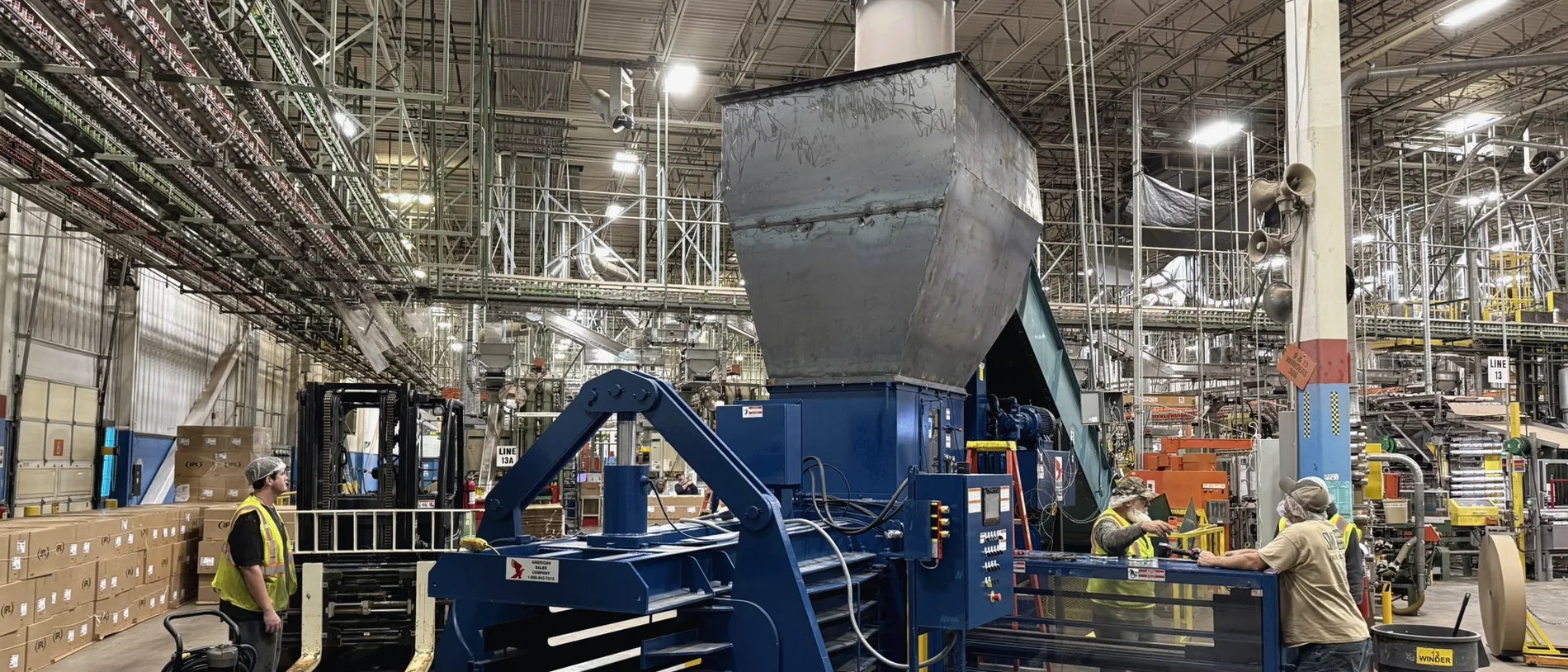
A baler turns approved recyclables into tied bales for handling and recycling. A compactor compresses material inside a receiving container for collection. Separate clean cardboard from mixed or wet waste first; your facility may need both machines. Choose using volume, labor, recycler requirements, and total installed cost.
In this guide
One machine or both? Follow the material
- Can clean cardboard or another approved material be separated and accepted by a recycler? Evaluate a baler.
- Does the remaining general waste require frequent pickups? Evaluate a commercial compactor.
- Are both streams substantial? Compare separate systems using the full handling and hauling costs.
- Confirm wet versus dry waste, recycler acceptance, loading, and hauler access before specifying equipment.
A self-contained compactor may suit appropriate wet waste. A stationary compactor is commonly considered for dry waste. The exact machine must be rated for the material. Ask for a waste stream evaluation if the answer is unclear.
Balers and compactors both reduce the volume of material, but they solve two different problems. The easiest way to understand the difference is this: A baler is usually used to prepare recyclable material for recycling. A compactor is usually used to reduce the volume of waste that will remain inside a container for collection or disposal. That distinction affects everything from the type of material you can process to your hauling costs, labor requirements, sanitation concerns, and potential recycling value. Some businesses need a baler. Some need a compactor. Many facilities need both.
The correct decision starts with understanding what is coming out of your building and where it needs to go next.
Baler vs. Compactor at a Glance
| Question | Baler | Compactor |
|---|---|---|
| Primary purpose | Process recyclable materials | Reduce waste volume |
| Typical material | Cardboard, paper, plastics, other approved recyclables | General waste or application-specific waste |
| Final output | Tied bale | Compacted material inside a container |
| Recycling focus | High | Depends on application |
| Wet waste | Generally not the application | Self-contained compactors are commonly used for appropriate wet waste applications |
| Cardboard | Common application | Possible in some systems, but may sacrifice recycling value if mixed with trash |
| Typical goal | Recovery, storage, transport, recycling | Fewer pickups, cleaner handling, volume reduction |
| Could a facility use both? | Yes | Yes |
What Does a Commercial Baler Do?
A baler compresses approved recyclable material into a dense bale that can be tied, removed, stored, and transported. Cardboard is one of the most common materials. Instead of filling a dumpster with loose boxes, a business can separate the cardboard and process it into manageable bales. Depending on the operation, those bales can then be collected by a recycler. Balers are available in several configurations, including:
- Vertical balers
- Horizontal balers
- Auto-tie systems
- Two-ram balers
- Specialty balers
The right type depends on material, volume, workflow, labor, and the requirements of the recycler receiving the material.
What Does a Commercial Compactor Do?
A commercial compactor reduces the volume of material being placed into a receiving container. The goal is usually to fit more waste into each load and reduce the amount of space loose trash occupies. Two common categories are:
Stationary compactors
Stationary compactors are commonly used with dry waste applications. The compactor remains on site while the receiving container can be removed for hauling.
Self-contained compactors
A self-contained system keeps the compactor and container integrated, making it useful for appropriate applications where liquids or wet waste are a concern. Grocery stores, food operations, hospitals, hotels, retailers, warehouses, manufacturers, and other commercial facilities can all use compactors, but the correct machine depends on the specific waste stream.
Start With the Destination of the Material
One of the best ways to choose between a baler and compactor is to ask: Where should this material go? If clean cardboard has a viable recycling outlet, mixing it into general trash may mean paying to dispose of something that could have been separated. If the material has little recycling value and is headed for disposal, a compactor may make more sense. Waste equipment should support the destination of the material. It should not determine it.
When a Baler Makes More Sense
A baler may be a better fit when your facility generates significant quantities of clean, recyclable material. Common examples include:
- Corrugated cardboard
- Paper
- Plastic film
- Certain rigid plastics
- Other approved recyclable commodities
The benefits can include:
Less loose material
Cardboard can consume enormous amounts of space when left uncompacted.
Easier storage and handling
Properly produced bales create a more organized material stream than piles of loose boxes.
Better transportation efficiency
Dense bales can be more efficient to store and transport.
Potential commodity value
Depending on the material, quality, local market, volume, and recycler, baled recyclables may have value.
Better separation
A baler can support a recycling program by keeping recyclable materials separate from general waste.
When a Compactor Makes More Sense
A compactor is typically the better choice when your biggest problem is the volume of general waste. Examples include:
- Mixed commercial trash
- Packaging waste that is not being recovered separately
- Appropriate wet waste applications
- High-volume waste streams requiring frequent hauling
The potential benefits include:
Fewer container pulls
More material can fit into a compacted load than into a container filled with loose waste.
Cleaner waste areas
Properly designed waste handling can reduce loose bags, overflowing containers, and clutter.
Better use of space
A compactor can dramatically change how much space uncompressed waste occupies.
Improved waste flow
Facilities can move trash directly into a centralized system instead of relying solely on open containers or repeated manual handling.
Some Businesses Need Both
A grocery store, for example, may generate:
- Large quantities of clean cardboard
- Plastic film
- Food waste
- General trash
- Damaged packaging
One machine does not necessarily make sense for every material. The grocery store may bale clean cardboard while using a self-contained compactor for an appropriate wet waste stream. A distribution center may bale corrugated cardboard while compacting remaining general waste. A manufacturer may use separate equipment for recyclable production material and non-recyclable trash. The goal is not to buy the fewest machines possible. The goal is to create the most efficient waste system.
Cardboard Is Where Businesses Often Make the Wrong Decision
Suppose your business fills open-top containers with loose cardboard. A compactor might reduce the volume. But that does not automatically mean compacting cardboard into the trash stream is the best financial decision. Before deciding, ask:
- Can the cardboard be separated cleanly?
- Will a recycler accept it?
- Is there enough volume to justify baling?
- What are you currently paying to haul it away?
- How much employee time is spent handling boxes?
- How much room does loose cardboard consume?
- Would a baler produce a material your recycler wants?
The best solution requires looking at the entire economics of the waste stream.
Wet Waste Changes the Conversation
Moisture is an important dividing line. If a business regularly handles wet waste, leakage, sanitation, and container design become major considerations. A self-contained compactor may be appropriate for many wet waste applications because the compactor and receiving container are designed as an integrated system. A typical cardboard baler is not the answer to a wet mixed-waste problem. Material identification should always happen before equipment selection.
Think Beyond the Purchase Price
A cheaper machine can become an expensive system if it creates the wrong workflow. Consider:
- Equipment cost
- Installation
- Electrical requirements
- Concrete and site preparation
- Labor
- Hauling frequency
- Recycler requirements
- Baling wire
- Maintenance
- Service access
- Downtime
- Storage
- Equipment life
The best purchase is the one that improves the total system.
Example: Retail Store
A retailer receives merchandise in cardboard boxes throughout the week. Most of its bulky waste is clean corrugated cardboard. A vertical baler may allow employees to separate the cardboard, reduce storage space, and prepare it for recycling. The remaining trash volume may not justify a large compactor. Likely priority: Evaluate a baler.
Example: Grocery Store
A grocery operation generates large quantities of cardboard plus wet and food-contaminated waste. The streams have very different handling needs. Likely priority: Evaluate a baler for clean cardboard and a self-contained compactor for the appropriate wet waste stream.
Example: Distribution Center
A large distribution center generates cardboard continuously across multiple shifts. Loose boxes create material handling problems and fill containers quickly. Likely priority: Evaluate a high-throughput baling system and a compactor for remaining waste.
Example: Commercial Property
A commercial property generates bags of mixed tenant trash with limited recoverable cardboard at the central waste point. Frequent dumpster pickups are the biggest problem. Likely priority: Evaluate a compactor.
Five Questions That Usually Reveal the Answer
Before buying anything, answer these:
- What materials are we generating?
- How much of each material do we generate?
- Where does each material go?
- What does the current system cost us?
- What would the ideal workflow look like?
A baler and a compactor are both excellent machines when installed for the right reason. They can both be expensive mistakes when installed for the wrong one. Norton Equipment Company has been working with commercial waste and recycling equipment since 1997. We sell, install, service, and rebuild balers and compactors across the Mid-South. Because we work with both categories, we can start with the material stream instead of trying to force every operation into one type of equipment.
If you are deciding between a commercial baler, trash compactor, or a combination of both, contact Norton Equipment Company for a waste stream evaluation and equipment recommendation.
