
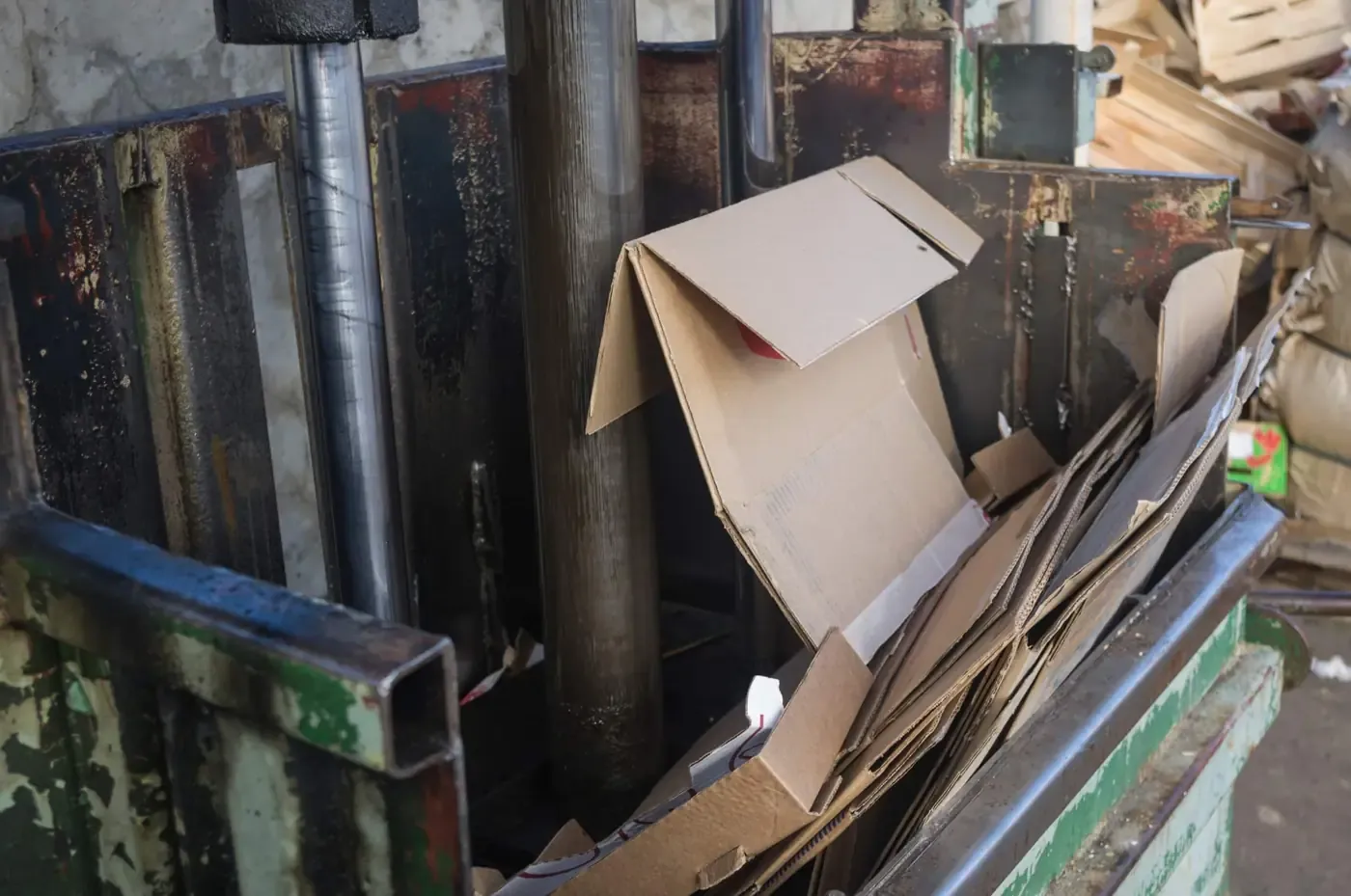
Only trained, authorized employees who are 18 or older may operate or unload a cardboard baler. Workers who are 16 or 17 may load one only when the machine meets ANSI Z245.5, cannot cycle while loading, and carries the required Department of Labor notice. Training must cover loading limits, the emergency stop, bale ejection, wire tying, and the rule that jams are cleared under lockout, never by hand.
In this guide
Why this guide exists
A cardboard baler is a slow machine. The ram takes most of a minute to travel, there is no blade, and nothing about it looks dangerous from across a back room. That is exactly why it hurts people. Balers injure workers who reach into the chamber to free a stuck box, who climb on the door to stamp material down, who bypass an interlock so a jammed machine will cycle, or who stand under a bale as it tips out of the chamber. NIOSH fatality investigations describe the same handful of scenarios over and over, and almost every one involved an operator who had not been trained on the specific machine or a safeguard that had been defeated.
This guide is for the store manager, warehouse lead, or safety coordinator who has a baler in the building and needs to know what the rules actually say, who is allowed to touch the machine, and what a training program has to cover. It applies to vertical downstroke balers first, because that is what most retail, grocery, and warehouse back rooms run, with notes for horizontal balers and compactors where the rules differ. It is written from the dealer side: Norton has installed, serviced, and retrained operators on these machines across the Mid-South since 1997.
It is not a substitute for the manufacturer’s manual, your facility’s written procedures, or legal advice. Where the rules below and your manual disagree, follow the manual and ask the manufacturer.
The rules that actually apply to a baler
There is no OSHA standard written specifically for balers. People look for one and conclude there are no rules. There are, and they come from three places.
| Rule | What it covers | Who it binds |
|---|---|---|
| OSHA 29 CFR 1910.212 (machine guarding) | Points of operation, nip points, and moving parts must be guarded so no part of the operator’s body is in the danger zone during the cycle. On a baler this is the chamber door, its interlock, and the gate or safety bar. | Every employer |
| OSHA 29 CFR 1910.147 (lockout/tagout) | Servicing and maintenance, which includes clearing jams, requires the machine to be isolated from its energy source and locked out by an authorized employee following a written procedure. | Every employer with powered equipment |
| OSHA General Duty Clause, Section 5(a)(1) | Where no specific standard applies, the employer must still provide a workplace free of recognized hazards. OSHA cites baler incidents under this clause and under 1910.212 and 1910.147. | Every employer |
| ANSI Z245.5 (baling equipment) | The voluntary consensus standard for the design, installation, maintenance, and operation of balers: guarding, interlocks, key-controlled switches, warning labels, and operator training. OSHA and the Department of Labor both reference it. | Manufacturers, installers, owners, and operators who adopt it; required for the minor-loading exception below |
| FLSA Hazardous Occupations Order 12, 29 CFR 570.63 | Federal child labor rule for paper-products machines. Prohibits anyone under 18 from operating or unloading a baler or compactor, with a narrow exception that lets 16 and 17 year olds load one. | Every employer with workers under 18 |
| OSHA 29 CFR 1910.132 (PPE) and 1910.178 (forklifts) | Eye and hand protection where wire and cardboard edges create a hazard; forklift training and certification for anyone moving finished bales. | Every employer |
State plans in Tennessee (TOSHA) and other state-plan states enforce standards at least as strict as the federal rules above. Mississippi and Arkansas are federal OSHA states. The requirements in this guide are the federal floor.
Who is allowed to operate a baler
Two filters decide this: age and training.
Workers under 18: the federal rule retail managers get wrong
Hazardous Occupations Order 12 prohibits anyone under 18 from operating or unloading a scrap paper baler or a paper box compactor, and from assisting in either. That part is absolute. No training certificate or parental permission changes it.
Congress carved out one exception in 1996 and the Department of Labor spelled out its conditions in 29 CFR 570.63. A 16 or 17 year old may load a baler or compactor, and only load it, when all of the following are true:
- The machine meets ANSI Z245.5-1990 for balers (or ANSI Z245.2-1992 for compactors), or a later edition the Department of Labor has determined is at least as protective. The manufacturer’s compliance plate or documentation is how you prove this.
- The machine includes an on-off switch with a key lock or an equivalent system, and the key or control stays in the custody of an employee who is 18 or older.
- The machine cannot be operated while it is being loaded. On a compliant vertical baler the door interlock does this: the ram cannot cycle while the loading door is open.
- The employer posts a notice on the machine stating that it meets the applicable ANSI standard, that 16 and 17 year olds may load it but may not operate or unload it, and that no one under 16 may load, operate, or unload it.
Workers under 16 may not load, operate, or unload under any condition. “Unloading” includes tying off and ejecting the bale, so a 17 year old who loads the chamber must step away and let an adult finish it. The Department of Labor’s Fact Sheet 57 walks through the notice requirement and the list of approved standard editions. If your baler predates the 1990 standard or has no compliance documentation, the exception does not apply and nobody under 18 may touch it.
Workers 18 and older: authorized means trained and named
Being an adult is the floor, not the qualification. OSHA’s expectation, and ANSI Z245.5’s requirement, is that only employees who have been trained on that specific machine and designated by the employer operate it. In practice this means a written list of authorized operators per machine, a signed training record for each, and a key or access control that keeps everyone else off it. A new hire with five years on a different brand of baler is not authorized on yours until someone trains them on yours.
What operator training must cover
ANSI Z245.5 requires the employer to train operators before they use the machine and to cover the manufacturer’s instructions, the hazards, the safeguards, and the procedures for normal operation and for abnormal conditions. The table below is the content Norton covers when installing a baler and retraining a crew, organized so you can use it as a syllabus. The printable operator training checklist has the same items with sign-off lines.
| Topic | What the operator must be able to do | Why it is on the list |
|---|---|---|
| Pre-shift inspection | Walk around the machine; confirm guards, door, latch, and interlock are intact; confirm the emergency stop is reachable; look for hydraulic fluid on the floor; confirm wire supply. | Most defeated safeguards were damaged first and worked around second. The walk-around catches damage before someone improvises. |
| Controls and the emergency stop | Identify every control on the panel, start and stop the ram, and hit the emergency stop from the operating position without looking for it. | Operators freeze under stress. The stop has to be muscle memory. |
| Approved material and loading limits | Load only the material the machine is rated for, flattened, below the fill line; keep hands and arms outside the chamber opening at all times; never load while the ram is moving. | Overfilling causes jams and bridging. Jams invite reaching in. |
| The chamber is off limits | State the rule: no body part enters the chamber for any reason while the machine is energized. Material that will not go in is pushed with the door or with an approved tool from outside, never by hand or foot. | Reaching into the chamber during a cycle is the leading cause of baler amputations and fatalities in NIOSH reports. |
| Cycle and full-bale indication | Recognize the full-bale light, gauge, or ram position that means the bale is ready; stop loading at that point. | Operators who keep stuffing a full chamber create jams and oversize bales. |
| Wire tying | Thread ties through the chamber slots from the outside, twist off correctly, keep eyes protected from wire ends, and know the number of ties the machine requires. | Wire ends cut hands and eyes. Under-tied bales burst during ejection or handling. |
| Bale ejection | Open the door only when the ram is at the top and the machine is stopped, stand clear of the tip path, use the ejector, and never pull a bale by hand or stand in front of a tipping bale. | A 60 inch bale weighs more than a refrigerator. A 72 inch bale can exceed 1,000 pounds. |
| Bale handling | Only forklift-certified employees move bales; stack per the facility’s limit; keep bale storage out of aisles and away from exits. | Crushing injuries during handling are as common as chamber injuries and far less discussed. |
| Jams and faults | Stop the machine, remove the key, report to the supervisor. Do not open panels, do not bypass the door switch, do not reach in. Jam clearing is done under lockout by an authorized person. | This is the single rule that prevents most serious baler injuries. |
| When to stop and call service | Describe the stop conditions: ram drifts or stalls, door will not latch, interlock does not stop the cycle, hydraulic leak, grinding or banging, burning smell, any safety device that does not work. | An operator who can name the stop conditions does not have to decide under pressure. |
| Housekeeping and the work area | Keep the floor around the machine clear of loose cardboard, wire scrap, and fluid; keep the emergency stop and the door swing unobstructed. | Slips and trips around balers are routine recordables. Clutter also hides leaks. |
| PPE | Cut-resistant gloves for wire and cardboard edges, safety glasses when tying, and footwear the facility requires for bale handling. | Site rules may add more. These are the minimum that matter around wire. |
The three habits that cause most baler injuries
If a training session can only drive home three things, these are the three.
1. Reaching into the chamber
A box bridges across the chamber. The operator reaches in to knock it down. A coworker, or the operator’s own knee, hits the start button. Or the operator leans in while the ram is still at the top of its stroke and the cycle resumes. Every version ends the same way. The rule is absolute: nothing enters the chamber while the machine is energized. Bridged material is cleared by closing the door and cycling, or by stopping the machine, removing the key, and letting an authorized person deal with it under lockout.
2. Bypassing the interlock
The door interlock is what makes a vertical baler legal to load. When it fails, the machine will not cycle, and someone taps the switch, tapes it closed, or jumpers the circuit so the shift can finish. From that moment the machine can crush an arm with the door open, and the minor-loading exception described above no longer applies because the machine no longer meets the standard. A failed interlock is a stop-and-call-service condition. The baler stays down until it is repaired.
3. Treating the bale as harmless
Operators respect the ram and ignore the bale. A finished vertical bale weighs several hundred to more than a thousand pounds and comes out of the chamber by tipping forward. Standing in its path, pulling it by the wire, or trying to walk it out of the chamber without the ejector causes crush injuries that never make the ram statistics. Ejection is a two-step process: ram up and machine stopped, then eject with the operator clear of the tip path.
Lockout/tagout for jams and maintenance
OSHA’s lockout/tagout standard, 29 CFR 1910.147, applies whenever an employee could be exposed to the unexpected energization or movement of a machine during servicing. Clearing a jam is servicing. The standard has a narrow exception for minor servicing that is routine, repetitive, and integral to production, but only when the work is done using alternative measures that give effective protection. Pulling cardboard out of a baler chamber with the power on does not qualify, and OSHA has cited employers who argued otherwise.
A compliant jam-clearing procedure for a vertical baler looks like this. The exact steps come from the manufacturer’s manual and your facility’s written energy-control procedure.
- Stop the machine using the normal stop control, then the emergency stop.
- Notify affected employees that the baler is going down for service.
- Isolate the energy source. Turn the disconnect switch off at the panel. The key switch on the control panel is an operating control, not an energy isolating device, and does not count as lockout on its own.
- Apply the lock and tag. The authorized employee’s personal lock goes on the disconnect, with a tag identifying who applied it.
- Release stored energy. Balers store energy in the hydraulic system and in the raised ram. Follow the manual’s procedure for lowering the platen or blocking it before anyone reaches under it. Never work beneath a raised ram that is held only by hydraulic pressure.
- Verify isolation. Attempt to start the machine with the controls. Nothing should happen.
- Clear the jam, then remove tools and material, restore guards, and confirm everyone is clear.
- Remove the lock (only the person who applied it), restore power, and test the interlock before returning the machine to production.
Only employees the employer has designated and trained as authorized may perform these steps. Everyone else who works near the machine is an affected employee and must be trained to recognize a lockout and to never attempt to start a locked-out machine. The standard also requires a periodic inspection of each energy-control procedure at least annually, performed by an authorized employee other than the one using the procedure, and documented. If your baler has never had a written lockout procedure or an annual inspection of it, that is the first gap to close.
Training records: what to keep and what an inspector asks for
An OSHA compliance officer investigating a baler incident asks for the same documents every time. Keeping them current is most of compliance.
- The list of authorized operators for each machine, with the date each was trained and by whom.
- Training content: the syllabus or checklist used, matched to the manufacturer’s manual for the specific model.
- Lockout/tagout documentation: the written energy-control procedure for the baler, the list of authorized employees, training records for authorized and affected employees, and the annual periodic inspection certification.
- Machine documentation: the manual, the ANSI compliance plate or letter, and the posted Department of Labor notice if anyone under 18 loads the machine.
- Maintenance and inspection records showing interlocks and emergency stops were tested, which is where a maintenance checklist and a preventive maintenance program earn their keep.
How often to retrain: OSHA’s lockout standard requires retraining whenever job assignments change, a new hazard is introduced, procedures change, or an inspection shows an employee is not following the procedure. Most facilities add an annual refresher and retrain every operator after any incident or near miss. New hires and transfers are trained before they operate, not during their first week of operating.
Compactor training: the differences that matter
Search for baler training and half the results are about compactors, because the rules overlap. Hazardous Occupations Order 12 covers both, and the loading exception for 16 and 17 year olds applies to paper box compactors meeting ANSI Z245.2. The hazards differ in a few ways worth calling out in a combined program:
- Chute and hopper doors. On a stationary or self-contained compactor, the charge box is loaded through a chute, hopper, or through-wall door. The door interlock and any gate must prevent the ram from cycling while a person could be in the charge box. Never climb into a hopper or chute to clear material.
- Key switches and remote starts. Many compactors start from a key switch at the loading point or from a remote station. Operators need to know every location the machine can be started from, because lockout must cover all of them.
- Container handling. Receiver containers are swapped by the hauler’s roll-off truck. Employees stay clear during pulls, and the compactor is never cycled with the container detached.
- Chute-fed apartment compactors start automatically when a photo eye sees material. Anyone servicing the trash room must lock out the compactor before working at the chute discharge.
The compactor maintenance checklist covers the operator observations that go with this training.
A baler safety program in one page
- Nobody under 18 operates or unloads. Sixteen and seventeen year olds load only on a documented ANSI-compliant machine with a key switch held by an adult, a door interlock that prevents cycling while loading, and the DOL notice posted.
- Only named, trained, authorized adults run the machine. Keep the list and the training records.
- Nothing enters the chamber while the machine is energized. Ever.
- A failed interlock, guard, or emergency stop takes the machine out of service until it is repaired.
- Jams are cleared under written lockout/tagout by an authorized employee, with stored hydraulic energy released and the ram blocked.
- Bales are ejected with the ram up and the machine stopped, with the operator clear of the tip path, and moved only by forklift-certified employees.
- Retrain annually, after any incident, and whenever the machine, the procedure, or the job changes.
Where Norton fits
Norton installs balers with operator training included, retrains crews on machines we did not sell, and tests interlocks, key switches, and emergency stops as part of every preventive maintenance visit. If a safeguard on your baler is damaged or bypassed, call (662) 838-7900 and take the machine out of service until it is fixed. If you are not sure whether an older baler meets the ANSI standard, an equipment evaluation documents the condition of its guarding and controls so you can make the call with facts.
