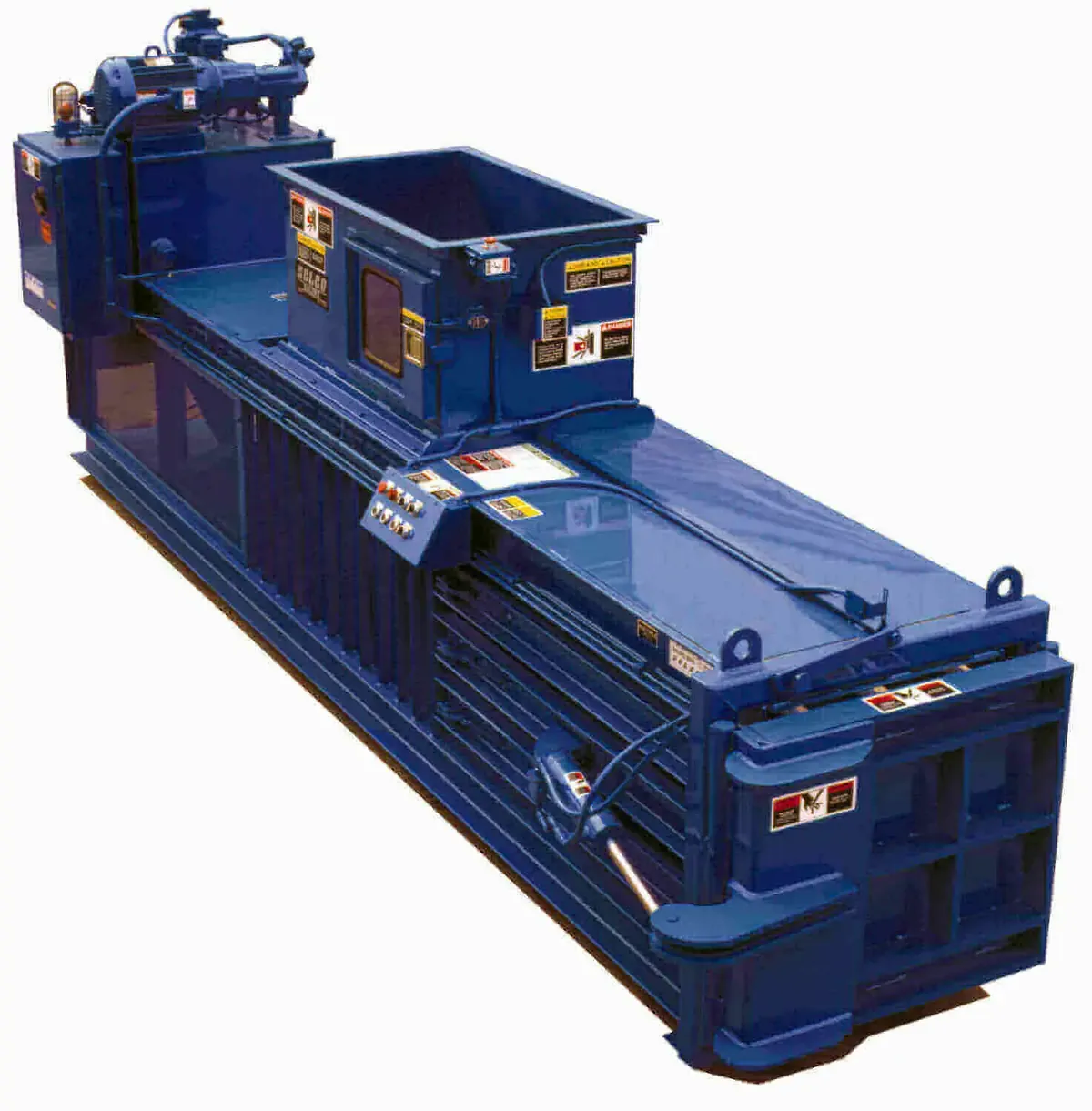
A horizontal baler is the right machine once cardboard volume passes roughly 15 to 20 tons a month or baling has become someone’s full-time job. Closed-door manual-tie balers fit growing operations at the lower end of that range. Open-end auto-tie balers run continuously from a conveyor for distribution centers and recyclers. Two-ram balers handle multiple materials and the highest volumes. Each step up adds throughput, automation, footprint, power, and price.
In this guide
Who this guide is for
You have a vertical baler, or several, and someone is standing at it most of the shift. Or you are planning a distribution center, a recycling line, or a plant with continuous packaging waste and the question is not whether to bale but how. Horizontal balers are built to order, which means the catalog is confusing and the prices are not published. This guide explains the three horizontal designs, what each one is for, what it needs from your building, and what it costs, so that the conversation with a dealer starts from the right machine.
Norton sells, installs, and services horizontal and two-ram balers across the Mid-South and rebuilds them in Byhalia. We also sell vertical balers, which is why the first section is about not buying a horizontal baler before you need one.
Vertical or horizontal: the one-table answer
A vertical baler compresses downward into a chamber the size of a doorway. An operator loads it, cycles it, ties the bale, and ejects it. A horizontal baler compresses sideways through a long chamber fed from an open hopper, and the design scales from a manual-tie machine to a fully automatic line.
| Factor | Vertical baler | Horizontal baler |
|---|---|---|
| Cardboard volume | A few bales a week up to roughly 15 tons a month | Roughly 15 to 20 tons a month and up; auto-tie and two-ram machines process that in a shift |
| Throughput | One bale per 20 to 40 minutes of operator time, depending on size | Closed-door: about 1 to 3 tons an hour. Auto-tie: several tons an hour from a conveyor. Two-ram: higher still on mixed materials |
| Operator time | Load, cycle, tie, eject by hand; a few minutes per cycle | Closed-door: load and tie. Auto-tie and two-ram: minimal, fed by conveyor or cart tipper |
| Bale weight | About 100 to 300 pounds on a 30 inch machine, 600 to 1,000 on a 60 inch, 750 to 1,100 on a 72 inch high-density | About 800 to 1,200 pounds on a closed-door, 1,000 to 1,800 on an auto-tie, 1,200 to 2,000 or more on a two-ram |
| Footprint | Roughly the floor area of a doorway plus loading and ejection space | A long chamber plus hopper, conveyor or feed area, and bale exit; often 30 to 60 feet of line |
| Power | Many run 208 to 230 volt single-phase; larger units three-phase | Three-phase, commonly 230 or 460 volt, with motors from about 20 horsepower upward |
| Who it fits | Retail, grocery, hotels, warehouses with moderate cardboard, schools, manufacturers with one packaging stream | Distribution centers, recyclers, printers and converters, bottlers, plants baling continuously or baling several materials |
| Typical new price | About $6,000 to $20,000 | Closed-door from about $30,000; auto-tie and two-ram systems scale well beyond that |
The honest rule: most stores, restaurants, hotels, and mid-size warehouses should run a 60 or 72 inch vertical and grow into a horizontal only if volume forces it. Distribution centers, recyclers, and plants baling all day should skip straight to a horizontal sized with headroom. If you are between those, the baler sizing guide and its worksheet turn your peak volume into a usable throughput requirement.
Closed-door horizontal balers
A closed-door horizontal, sometimes called a manual-tie horizontal, is the entry point. Material is loaded into the hopper by hand, cart tipper, or a short conveyor. The ram compresses it sideways against a closed end door until the bale reaches length. The operator then opens the door, ties the bale with wire by hand through slots in the chamber, and the ram pushes the finished bale out.
- Throughput: commonly 1 to 3 tons of cardboard an hour, limited mostly by how fast the hopper is fed and how long tying takes.
- Typical bale: 800 to 1,200 pounds of OCC, roughly 30 by 48 inches in section and 48 to 60 inches long, dense enough for mill acceptance.
- Labor: an operator is still involved at every bale, but loading is continuous and the machine does the compressing while they do other work.
- Who buys it: operations that have outgrown a 72 inch vertical, retailers consolidating cardboard from several stores, manufacturers with a single packaging stream and one or two shifts.
- Wire: single-loop or double-loop bale ties, longer and heavier than vertical ties because the bale is bigger and denser.
Open-end auto-tie horizontal balers
An open-end auto-tie baler runs continuously. Material arrives on a conveyor or air system into the hopper, a photo eye starts the ram, and the ram compresses each charge against the previous bale in a chamber with no end door. When a bale reaches length, an automatic wire tier wraps and knots it with four to six strands of wire, and the next bale pushes it out the end onto the floor or a bale conveyor. No one has to be at the machine.
- Throughput: several tons an hour on OCC, set by ram force, chamber size, and conveyor feed. Models range from compact units for a single distribution center to machines that bale 20 or more tons an hour.
- Typical bale: 1,000 to 1,800 pounds at mill density, uniform in size, which is what buyers pay for.
- Labor: minimal. Someone keeps the conveyor fed and moves finished bales. Wire is loaded by the box or stem.
- Who buys it: distribution and fulfillment centers, recyclers, printers, converters, bottling and packaging plants, any site where cardboard arrives all shift.
- Wire: boxed or stem wire in the gauge the tier is built for, run through the automatic tier. Wire choice affects tier reliability more than anything else on the machine.
Two-ram balers
A two-ram baler separates compressing from ejecting. The main ram compresses material against a fixed wall in a chamber that is loaded from above. When the bale is complete, a second ram ejects it sideways, out of the way of the next charge, while an automatic tier wraps it. Because the chamber is open at the top and the eject stroke clears it completely, the machine can switch materials between bales and produce very dense bales of material that a single-ram machine struggles with.
- Throughput: the highest of the three, and the most forgiving of mixed and springy material.
- Typical bale: 1,200 to 2,000 pounds or more, export density, in a consistent size.
- Materials: OCC, mixed paper, PET and HDPE containers, film, aluminum cans, non-ferrous metals, and other commodities, often several in the same shift.
- Who buys it: recycling processors and material recovery facilities, large manufacturers with multiple recyclable streams, consolidation and transfer operations.
- Why it costs more: two large cylinders, a heavier structure to resist the compressive loads of dense plastics and metals, bigger motors and power units, and controls that manage material changeovers. It is a capital project with a longer lead time, and it is almost always fed by a conveyor and surrounded by sorting and bale-handling equipment.
Sizing a horizontal baler by volume
Average volume hides the bottleneck. Size to the busiest period, with headroom.
- Measure peak material. Weigh or estimate the cardboard generated during the busiest shift or receiving window, not the weekly average. The sizing worksheet records this.
- Convert to pounds per hour. Peak pounds divided by the hours available to bale during that window is the throughput the machine and its feed system must sustain, before allowing for breaks, tying, and interruptions.
- Pick the feed. Hand or cart loading tops out quickly. A floor conveyor or cart tipper is what lets an auto-tie machine reach its rated throughput. Pit conveyors keep the floor clear but need a pit.
- Check the bale against the recycler. Ask what bale weight and dimensions the buyer or mill wants. Heavier bales fill trailers to weight and bring the best price, but every bale has to be moved by your forklift.
- Add growth. A machine sized to today’s peak is undersized the first year volume grows. Specify headroom, not maximum.
Bale weight drives the revenue side of this math. The cardboard bale weight guide covers typical weights by machine and what a bale is worth.
What a horizontal baler needs from your building
- Floor space. The baler, its hopper, the conveyor or feed area, bale exit, bale staging, forklift aisles, and service access. A compact auto-tie line can need 30 to 60 feet in length. Walk it with a tape before you shop.
- Floor and pit. Horizontal balers are heavy, commonly 15,000 to 40,000 pounds and more for two-ram machines, and need a slab rated for it. A pit conveyor needs an excavated and formed pit. Floor-level conveyors avoid the pit at the cost of a ramp or more floor space.
- Power. Three-phase service sized to the power unit, often 460 volt, with a disconnect at the machine. Auto-tie and two-ram machines can draw well over 50 horsepower across motors. Confirm what the dock has before anything is ordered.
- Ceiling height. Hoppers, conveyor discharge heights, and any dust or air system need clearance, and a two-ram chamber loaded from above needs more than a closed-door machine.
- Bale handling. A forklift rated for the bale weight with clamp or forks, a staging area, and a loading path to the trailer. Plan bale storage for a missed pickup.
- Delivery access. The machine arrives on a flatbed and is set by crane or heavy forklift. Rigging and installation are part of the project, not an afterthought.
New, used, and refurbished horizontal balers
Horizontal balers are mostly heavy steel and hydraulics, which makes a rebuilt machine a serious option. The used versus refurbished guide explains the difference in detail. In short, a used baler is sold as-is, inspected and described but not rebuilt. A refurbished baler has been through Norton’s shop in Byhalia: cylinders resealed or rebuilt, hydraulics flushed and tested, wear surfaces and chamber repaired, controls and safety circuits verified, cycle-tested under load, and covered by a shop warranty. Refurbished costs roughly half of new.
What to inspect on any used horizontal baler before you buy, or have a Norton evaluation inspect for you:
- Ram face, chamber floor, and side liners for wear, scoring, and gaps where material can wedge.
- Main cylinder rod and seals for scoring and leakage; eject cylinder on a two-ram.
- Hydraulic power unit: pump noise, fluid condition, hose age, valve leaks, and whether pressures hold at specification.
- Shear blade or knife condition where the design has one.
- Wire tier on auto-tie machines: track wear, needle condition, knotter operation, and fault history. The tier is the most maintenance-intensive part of the machine.
- Controls: PLC and HMI age, photo eyes, limit switches, emergency stops, and interlocks on hopper doors and access panels.
- Structure: cracks at cylinder mounts, chamber welds, hopper, and feet.
- Hours, cycle count, fault log, and maintenance records if they exist.
Bale weight, density, and what the bale is worth
Recyclers and mills buy OCC by the ton, and they pay for density and cleanliness. A horizontal baler earns its price in two ways beyond labor: heavier bales fill a trailer to its weight limit in fewer bales, and uniform mill-size bales qualify for mill pricing rather than a dealer’s pickup rate. Published national averages for baled OCC moved through a wide range during 2026, roughly between $60 and $100 a ton depending on the month and region, and what a local buyer pays for picked-up bales is lower than the published mill price. Treat bale revenue as an offset to hauling cost, with the labor saving as the main return on a horizontal baler, and ask your recycler for a written price and pickup schedule before you size the machine to it.
What to bring to a horizontal baler quote
- Peak and average cardboard volume, by shift, and how it was measured.
- Other materials you might bale, now or later.
- A floor plan with the proposed location, ceiling height, and the path from receiving to the baler.
- Available power at the location: voltage, phase, and panel capacity.
- Your recycler’s bale requirements and pickup frequency.
- Forklift capacity and bale storage area.
- Whether new, refurbished, or used is on the table.
Norton scopes horizontal and two-ram projects as a complete line: machine, conveyor, power coordination, rigging, installation, wire, operator training, and service afterward. We quote new and refurbished side by side. Call (662) 838-7900 or describe your project and we will start with the material, not the machine.
