
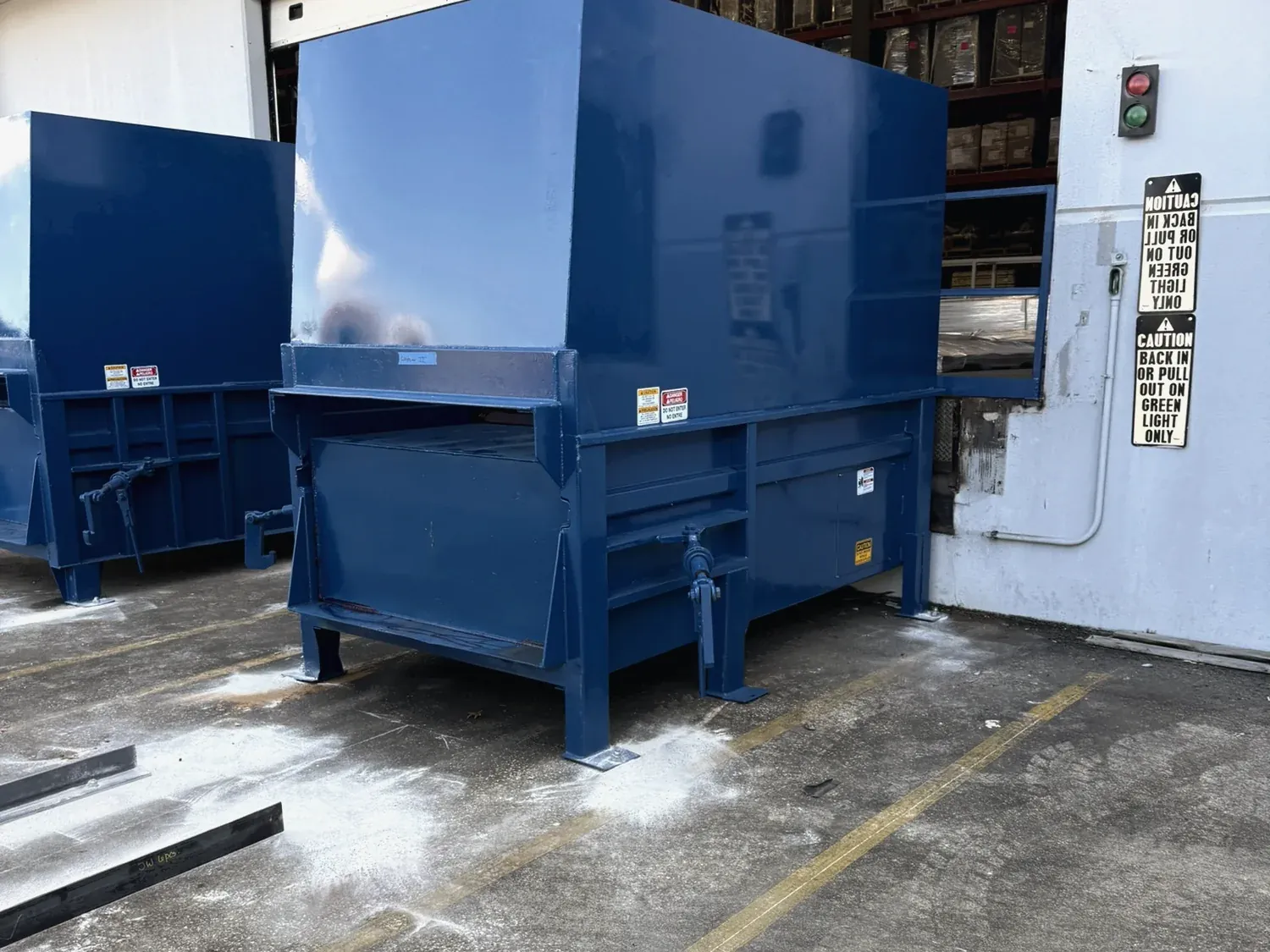
A new commercial trash compactor typically costs between about $8,000 for a small vertical unit and $60,000 or more for a large pre-crusher or auger, before installation. Self-contained compactors for wet waste commonly run $20,000 to $45,000 and stationary compactors $15,000 to $35,000 plus a receiver container. Installation adds a concrete pad, three-phase power, and often a chute or enclosure. Reconditioned machines cut the equipment price by roughly 30 to 60 percent.
In this guide
The short version, then the long one
Search for the price of a commercial trash compactor and you get residential kitchen units, municipal fee schedules, and manufacturers who will not publish a number. This guide gives you the numbers a dealer actually works with: what each type of machine costs, what the installation adds, how a reconditioned unit changes the math, what the hauler’s “free” compactor really costs, and how to work out whether any of it pays back for your site. The ranges are planning ranges. The quote for your machine depends on specification, condition, site preparation, delivery, and installation, and that is the number to make decisions on.
Compactor prices by type
Commercial compactors fall into five families, and the family decides the price band before any option does. If you are not sure which family fits your waste, the buying guide covers types and sizing and the self-contained versus stationary comparison settles the most common question.
| Compactor type | Typical new price | What drives the number | Common applications |
|---|---|---|---|
| Vertical and apartment | About $8,000 to $20,000 | Container size (2 to 8 yard front-load), chute-fed versus hand-fed, controls and guarding | Apartments, high-rise trash rooms, small retail, restaurants |
| Stationary | About $15,000 to $35,000, plus receiver container | Charge box size (2 to 6 yards), compaction force, cycle time, feed configuration, power unit | Warehouses, distribution centers, retail, manufacturing |
| Self-contained | About $20,000 to $45,000 | Total capacity (roughly 15 to 35 yards), liquid-tight construction, charge chamber size, sump and drain options | Grocery, restaurants, hospitals, hotels, food processing |
| Pre-crusher | About $30,000 to $60,000 or more | Crushing force, breaker door, structural gauge, charge box size | Manufacturing, pallets and drums, product destruction |
| Auger | About $30,000 to $60,000 or more | Screw diameter and drive, hopper and feed system, container interface | High-volume cardboard and wood waste, printers, packaging plants |
| Reconditioned, any type | Commonly 30 to 60 percent below new | Age, size, condition of the core, scope of the rebuild, warranty terms | Any of the above where capital matters more than a factory lead time |
About these numbers: they are planning ranges drawn from what commercial equipment typically sells for, not a quote. Every Norton quote depends on the exact specification, condition, site preparation, delivery, and installation. Call (662) 838-7900 for a number tied to your machine and your site.
What moves a compactor quote up or down
Two stationary compactors with the same charge box can differ by ten thousand dollars. These are the specifications behind the gap.
- Charge box and container size. A larger charge box accepts bigger items and more volume per cycle. A larger receiver container or self-contained body means fewer pulls but a bigger machine and a bigger pad.
- Compaction force and cycle time. Measured in pounds of ram force and seconds per cycle. More force packs denser loads and costs more in cylinder, power unit, and structure. High-force machines also demand more of the receiver container.
- Power unit. Most commercial compactors run three-phase power at 208, 230, or 460 volts. A tri-voltage power unit, a larger motor for faster cycles, or a remote power unit mounted inside the building all add cost.
- Liquid-tight construction. Self-contained units are fully welded with a sump to hold liquids. That construction is why they cost more than a stationary machine of similar capacity, and why they are the only right answer for wet waste.
- Feed configuration. Ground feed is the base. Dock feed, through-wall chutes, doghouses, hoppers, and cart tippers are added steel, and are usually quoted as installation rather than equipment.
- Controls and safety options. Key switches, remote start stations, full-container indicators, photo-eye auto start on chute-fed machines, and interlocked gates.
- Steel options. Walk-on and drive-on decks, enclosures, and guards are fabricated per site. They are not optional when a safety audit or a landlord says they are not.
Installation costs, line by line
Installation is where first-time buyers get surprised, because the equipment quote is the number they remember and the site work is the number they pay. The compactor installation guide explains each item in detail. Here is what the line items are and what tends to drive each one. Ranges are intentionally wide; the site decides.
| Line item | What it is | What drives the cost |
|---|---|---|
| Concrete pad | A reinforced pad sized for the compactor, the container, and the roll-off truck’s approach, typically six inches or more of reinforced concrete on compacted base. Many sites already have one that needs repair or extension. | Pad size, existing slab condition, drainage, local concrete pricing. Commonly several thousand dollars for a new pad. |
| Electrical service | A three-phase circuit from the panel to a fused disconnect at the machine, sized to the power unit. If the building lacks three-phase at the dock, the utility and electrician conversation comes first. | Distance from the panel, conduit route, whether three-phase exists, whether a service upgrade is needed. From modest to the single largest line on the job. |
| Chute, doghouse, or through-wall door | The steel that gets waste from inside the building into the charge box without walking it outside. Fabricated to the wall, the dock height, and the machine. | Opening size, wall construction, dock height, whether a security door or interlocked gate is included. A simple ground-feed install skips this entirely. |
| Delivery and rigging | Trucking the machine to the site, offloading, placement on the pad, anchoring, and hookup to the container. | Distance, access, whether the machine is set outdoors on a pad or threaded through a building. Norton’s own logistics crew handles this on machines we sell. |
| Commissioning and training | Pressure and cycle testing, interlock and safety verification, and operator training on the specific machine. | Usually included in a dealer installation. Confirm it is in writing. |
| Permits and inspections | Electrical permit for the new circuit, sometimes a building permit for the pad or an enclosure, occasionally a zoning or screening requirement. | Municipality. Enclosures in particular are often required by the jurisdiction or the landlord rather than chosen. |
| Old equipment removal | Disconnecting, extracting, and hauling the previous compactor or dumpsters. | Whether the old machine has value, how it comes out, and whether it is hauler-owned. |
A useful rule: get every one of those lines in the quote before you sign anything, and ask which are included and which are allowances. A compactor quote that stops at the machine is not a quote for a working compactor.
New, reconditioned, or the hauler’s machine: five years, side by side
There are three ways to put a compactor on your pad, and they have very different costs once you follow the money for five years. The new versus reconditioned versus hauler article covers the reasoning. The table puts numbers on it.
This example is hypothetical. It uses the middle of the stationary price range, a reconditioned unit at 45 percent below new, and a maintenance budget of a few hundred dollars per visit on a quarterly program. The hauler column assumes the equipment is bundled into a hauling contract at a monthly premium over open-market hauling rates, which is how the “free” machine is paid for.
| Cost over five years | New, owned | Reconditioned, owned | Hauler-supplied |
|---|---|---|---|
| Equipment | $25,000 | $13,750 | $0 |
| Installation (pad repair, power, chute) | $8,000 | $8,000 | $8,000 (site work is still yours) |
| Preventive maintenance, quarterly | $6,000 | $6,000 | Included in contract |
| Repairs outside maintenance | $1,500 | $3,000 | Included in contract |
| Hauling premium for bundled equipment | $0 | $0 | $18,000 ($300 a month over market rate) |
| Hauling contract leverage at renewals | Yours to bid | Yours to bid | None while their machine is on your pad |
| Residual value of the machine at year five | Resellable | Resellable | $0 |
| Five-year total | $40,500 | $30,750 | $26,000 plus every renewal you cannot bid |
The hauler column looks cheapest for exactly as long as you do not price the contract lock. The premium in the table is a placeholder; your own number is the difference between your bundled hauling rate and the rates you could get by bidding the work. On most sites that difference, compounded over every renewal, is larger than the entire new-versus-reconditioned gap. Owning the machine, new or reconditioned, is what keeps the hauling biddable.
How much a compactor saves per month
Hauling is billed per pull, not per pound. A compactor cuts the number of pulls, which is where the money is. The hauling bill article walks through the mechanism. The arithmetic you can do yourself looks like this.
- Count your pulls. How many times a week does a truck lift or pull a container, across every container on the site? Multiply by your per-pull charge, with surcharges, to get a monthly figure.
- Apply the compaction ratio. Dry commercial waste compacts at roughly 4 to 1. Divide weekly loose yards by four to get compacted yards, then divide by the receiver container size to see how often it fills.
- Price the new schedule. A roll-off pull costs more than a dumpster lift but happens far less often. Add container rent and disposal tonnage, which does not change much because the weight is the same.
- Subtract. The difference is the monthly saving. Divide the installed cost by it for the payback period.
A hypothetical example, the same one used elsewhere on this site so the numbers line up: a distribution operation running two 8-yard dumpsters pulled five times a week each at about $95 a pull with surcharges pays roughly $4,100 a month. The same volume through a 30-yard stationary compactor compacts into about one pull a week at roughly $450 plus disposal, about $2,300 a month with container rent. That is about $1,800 a month, or $21,600 a year. Against a $28,000 installed new machine the payback is around 16 months. Against a reconditioned machine it is under a year. Your invoices will produce a different number, which is why a waste stream consultation starts by reading them.
Rental and leasing
Norton does not advertise compactor rental, and most dealers who do are quoting a lease by another name. Leasing makes sense in three situations: a site you may leave within a few years, a capital budget that is closed for the year while the operating budget is open, and a seasonal operation that needs the machine for part of the year. In each case compare the total of lease payments against the owned cost above, ask who is responsible for maintenance and repairs, and read the end-of-term terms. A reconditioned machine often does what the lease was meant to do, at a lower total cost, with the machine yours at the end.
Questions to ask before you take a compactor quote
- Is this the equipment price or the installed price, and which installation lines are included?
- Will you quote new and reconditioned side by side?
- Who services the machine after the install, and where do they dispatch from?
- Does this deal tie my hauling contract to the equipment?
- What warranty applies, and what does it exclude?
- Will you model the payback from my own hauling invoices before I buy?
Norton has sized, sold, installed, and serviced commercial compactors across the Mid-South since 1997 and quotes new and reconditioned machines side by side with the installation spelled out. Call (662) 838-7900 or request a quote with your waste type and current pickup schedule.
